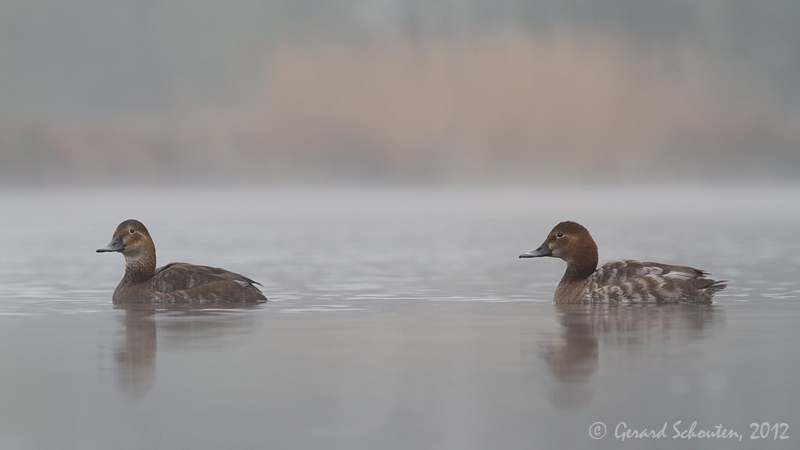
On this grey misty morning a Pochard ♀ (
Aythya ferina/Tafeleend) and a Tufted Duck ♂ (
Aythya fuligula/Kuifeend) came very close. Why? A possible explanation in the form of Aythya thoughts:
[Pochard] “What is that strange clicking sound? Let’s check it out. It seems to come from that black round hole in the shore vegetation. I don’t thrust it, let’s pretend to fall asleep and keep an eye on it from a distance ...”
* Canon EOS 7D with 300mm/f4 IS; ISO-400, f5.6, 1/200s; +0.7 stop; from beanbag.
[Tufted Duck] ”Hmm, why is that insipid Pochard female all the time in that corner of the pond? Probably she discovered delicious molluscs under the water surface. I’d better be careful because Pochards are big and strong, but above all they are really boring, I don’t like their scaly appearance. I really prefer the uniform brownish Anythia fuligula females, especially if they are young. Although the older ones, with some white around the bill base, seem to be better breeders. Let’s go a bit closer inconspicuously. I swim in that direction casuallywhile doing some feather care.”
* Canon EOS 7D with 300mm/f4 IS; ISO-400, f6.3, 1/200s; +0.7 stop; from beanbag.
[Pochard] “Ieeeek, that arrogant Tufted Duck is coming closer. What a poser with those sloppy hairs, he definitely need a proper haircut. I can easily chase it away, but let’s be decent and avoid a confrontation. I move on. By the way that clicking has not stopped yet …”
* Canon EOS 7D with 300mm/f4 IS; ISO-400, f5.6, 1/250s; +1.0 stop; from beanbag.
[Tufted Duck] “Allright she is gone. This was indeed smart tactics to get here without drawing too much attention. Hey what a funny sound. Further nothing special around, except for that round black hole in the vegetation; I did not notice that before. No molluscs either. Okay, let’s move on.”
* Canon EOS 7D with 300mm/f4 IS; ISO-400, f7.1, 1/320s; from beanbag.
[Pochard] “That black-and-white macho is gone sister. By the way, this is also the way they think. Anythia fuligula are somehow unable to see any shades of grey. But as I told you, it was near this place that I heard a very strange sound. Listen, there it is again. Do you know what it is?”
* Canon EOS 7D with 300mm/f4 IS; ISO-400, f7.1, 1/200s; from beanbag.
The moral of this little story is twofold: 1) Prejudices are the cause of many misunderstandings (as we all know of course), 2) If you try to think as your subject, your photography will improve.




 At Suininkikoski, east of Kuusamo, where a lake ‘empties’ into a fast flowing river open water can still be found. The last morning of my trip we went to this place to look for Dippers (Cinclus cinclus/Waterspreeuw). About 5 birds were present, one of them was even singing in these icy waters.

 Another day in the Oulanka forest hide; Golden Eagle (Aquila chrysaetos/Steenarend), Black Woodpecker (Dryocopus martius/Zwarte Specht), and Siberian Jay (Perisoreus infaustus/Taigagaai). Before today this could have happened only in my dreams!


 A magic day! In the afternoon we went to Kuntivaara, a hilltop east of Kuusamo, facing the Russian border. It was quite an adventure to get here by snow scooter. The idea was to photograph the sunset and the shadows of the rising moon on this snow-covered fjell. But things got even better; around 22.30 PM, quite as a surprise, the “rewontulet” (Finnish for Northern Lights) came. The greatest lightshow on earth in this spruce candle paradise was awesome! Something divine was writing in the sky, and the old snowy trees (and me!) were watching the play silently.


